

Su Filindeu: Sardinia’s Delicate Pasta Made by Repeatedly Stretching Dough

Italian cuisine is famous for its remarkable diversity of pasta shapes, textures, and preparation techniques. From familiar spaghetti to intricate stuffed varieties, each form reflects regional ingredients and generations of culinary craftsmanship. Among these traditions, Su Filindeu stands apart because of its extraordinary delicacy and demanding handmade process.
Originating in Nuoro, in the mountainous Barbagia region of Sardinia, Su Filindeu is a traditional pasta made by repeatedly stretching and folding dough into incredibly fine strands. Its name is commonly translated as “threads of God,” an expression that reflects the almost lace-like appearance of the finished pasta. Unlike machine-extruded pasta, its characteristic strands are formed through careful hand movements that require considerable experience.
The ingredients are remarkably simple. Traditional recipes use durum wheat semolina, water, and salt. Yet transforming these ingredients into a delicate network of threads requires exceptional control over moisture, elasticity, pressure, and timing. The pasta is arranged in overlapping layers and dried before being broken into pieces for cooking.
Su Filindeu is also deeply connected with Sardinian religious traditions. It has historically been prepared for pilgrims attending celebrations associated with Saint Francis of Lula. Served in rich sheep broth with pecorino cheese, it offers nourishment while connecting food with hospitality, faith, and community.
Today, Su Filindeu is recognised as one of Italy’s most unusual pasta traditions. Its survival depends on preserving the specialised knowledge required to make it, supporting its remaining practitioners, and helping new generations appreciate its cultural significance.
What Is Su Filindeu?
Su Filindeu is a traditional Sardinian pasta distinguished by its extremely thin strands and intricate, woven appearance. It is particularly associated with Nuoro and the surrounding Barbagia area, where the technique has been passed between generations.
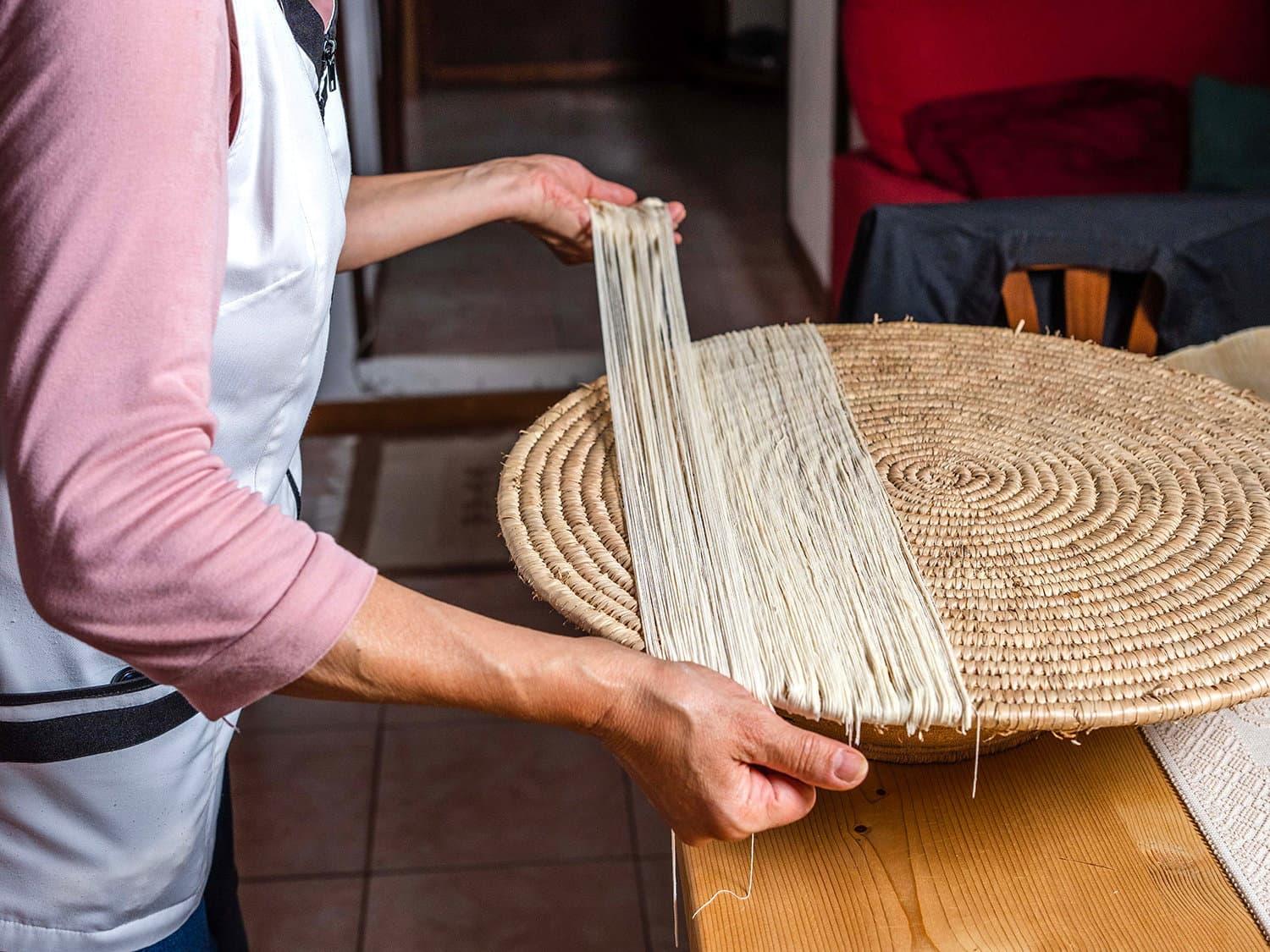
Unlike ordinary pasta, which is generally rolled, cut, or pushed through a die, Su Filindeu is formed by repeatedly stretching and folding an elastic mass of dough. Each movement divides the dough into progressively finer strands. The process continues until the desired thinness is achieved.
Traditional descriptions commonly explain that eight successive folding and stretching movements can produce 256 strands. These strands are then arranged in three overlapping layers, with each layer crossing the previous one. The resulting structure resembles a delicate textile made from pasta rather than a conventional bundle of noodles.
The finished pasta is usually dried before use. Once dry, the layered structure becomes firm and can be broken into manageable pieces. During cooking, the thin strands soften quickly, making them suitable for serving in hot broth.
Su Filindeu is sometimes described as one of the rarest pasta varieties in the world. This reputation reflects the difficulty of its preparation and the limited number of people who have mastered the traditional technique. Its importance, however, goes beyond rarity. It represents a specialised form of culinary knowledge that remains closely tied to Sardinian identity.
The Sardinian Origins of Su Filindeu
Sardinia is an island in the Mediterranean Sea with a distinctive cultural and culinary heritage. Its mountainous interior, coastal communities, pastoral traditions, and agricultural history have shaped a cuisine that differs from many mainland Italian food traditions.
Nuoro lies in the island’s central-eastern interior, within a region known for its strong local customs. Traditional Sardinian food often makes use of durum wheat, sheep’s milk cheese, and meat from animals raised in pastoral environments. Su Filindeu brings these ingredients together through an unusually intricate pasta-making process.
The technique has historically been preserved within a small number of families, particularly by women who passed their knowledge to daughters and younger relatives. This transmission depended on demonstration and practice rather than written measurements alone. A learner needed to observe how the dough responded to the hands and gradually develop the sensitivity required to reproduce the same movements.
The tradition is closely associated with the Sanctuary of San Francesco di Lula, near Nuoro. Pilgrims have travelled to the sanctuary for celebrations linked to Saint Francis, and Su Filindeu has traditionally been prepared as part of the hospitality offered there. Official Sardinian tourism sources describe it as a special food connecting pilgrimage, community, and regional culinary knowledge.
This regional connection explains why Su Filindeu cannot be understood simply as an unusual pasta shape. Its production and consumption belong to a wider cultural setting in which food helps maintain relationships between families, religious gatherings, and local identity.
Why Is Su Filindeu So Difficult to Make?
The difficulty of Su Filindeu comes from the relationship between a simple dough and a highly precise manual process. Semolina, water, and salt are familiar ingredients, but they must be combined and worked until the dough reaches a very specific degree of elasticity.
If the dough is too firm, it resists stretching and may break. If it is too soft or wet, the strands can lose their definition and stick together. Even when the consistency is suitable, the baker must apply pressure evenly and coordinate both hands to maintain a consistent thickness.
Temperature and moisture also influence the process. The dough may need to be moistened repeatedly with salted water to maintain the flexibility required for stretching. The baker must recognise when the surface is becoming dry and when the dough is ready for another movement.
The timing of each stretch matters because the strands must remain connected and evenly formed. Uneven pressure can create thick and thin sections, while careless folding can cause strands to overlap incorrectly. These flaws can affect both the appearance and the way the pasta behaves during cooking.
There is no universally sufficient written formula for mastering the technique. Measurements can help describe the ingredients, but they cannot fully communicate the feel of properly prepared dough. The required knowledge develops through repetition, observation, and feedback from experienced practitioners.
This combination of physical skill and sensory judgement makes Su Filindeu different from many contemporary pasta-making methods. The process cannot easily be reduced to a standard industrial sequence without changing the qualities that make the traditional version distinctive.
The Ingredients Behind This Delicate Pasta
Traditional Su Filindeu relies on three basic ingredients: durum wheat semolina, water, and salt. Their simplicity highlights the importance of technique rather than elaborate seasoning or complex ingredient combinations.
Durum wheat semolina provides the dough’s main structure. It is widely used in Italian pasta because its proteins and starches contribute to the texture needed for shaping and cooking. The precise characteristics of the semolina influence how the dough absorbs water and responds to repeated stretching.
Water hydrates the semolina and allows the dough to develop cohesion. The amount and distribution of moisture are particularly important because the dough must remain firm enough to hold together while becoming elastic enough to stretch into extremely thin strands.
Salt contributes flavour and is also used in the water applied during preparation. Traditional descriptions emphasise the repeated handling of the dough and the careful addition of salted water to maintain its workability. The amount used may vary according to the practitioner’s method and the properties of the semolina.
Unlike rich filled pastas, Su Filindeu does not depend on eggs, cheese, or butter in its basic dough. Its distinctive character emerges from the way the ingredients are transformed through skilled handwork.
This is one reason the pasta attracts attention from chefs and food researchers. It demonstrates that culinary complexity does not always require a long ingredient list. Sometimes, the greatest difficulty lies in understanding how a few basic materials behave when handled with precision.
The Repeated Stretching and Folding Technique
The defining stage of Su Filindeu production is the repeated stretching and folding of the dough. After the semolina, water, and salt have been combined, the dough is kneaded and worked until it reaches the elasticity required for the process.
The baker shapes a portion into an elongated piece and holds it with both hands. The dough is stretched outward, then folded back onto itself. This movement is repeated, progressively increasing the number of strands while reducing their individual thickness.
Traditional accounts describe eight successive folding stages that can produce 256 fine strands. The number illustrates the remarkable multiplication achieved through the technique, although the final quality depends on more than simply completing a fixed sequence. The strands must remain continuous, evenly stretched, and sufficiently separated to form the intended structure.
The hands perform a coordinated series of movements. The baker must control tension, keep the strands aligned, and maintain enough moisture to prevent the dough from breaking. These actions are learned through practice rather than through counting alone.
As the strands become finer, the work becomes more demanding. Small differences in pressure can have a greater effect, and the dough has less tolerance for mistakes. The baker must therefore work confidently while remaining attentive to changes in texture and elasticity.
The final strands are arranged carefully on a round surface. Traditionally, this may involve a base made from wooden material or a woven support associated with local practice. The strands are laid in successive layers that cross one another, producing the characteristic woven appearance.
The completed structure is both functional and beautiful. Its layered arrangement allows the delicate pasta to dry as a connected sheet before being broken apart for cooking.
Sun-Drying and Preserving the Pasta
Once the strands have been arranged into three overlapping layers, Su Filindeu is traditionally dried in the sun. This stage is essential because the pasta must become firm enough to handle and store without losing its woven structure.
The strands dry together, forming a thin sheet with a fragile, lace-like appearance. Their overlapping arrangement helps the layers remain connected as moisture evaporates. The drying process must be managed carefully because excessive handling can damage the delicate structure.
Traditional sun-drying reflects a wider pattern in Mediterranean food preservation. Before modern temperature-controlled equipment became common, sunlight and air were important tools for extending the useful life of foods. Drying pasta allowed it to be prepared ahead of time and used when needed.
The finished sheet is removed from its supporting surface after drying. It can then be broken into smaller pieces for cooking. Unlike fresh pasta that must be prepared shortly before a meal, properly dried Su Filindeu can be kept until it is required, provided that it is protected from moisture and stored hygienically.
The final product looks remarkably different from conventional dried pasta. Rather than separate cylindrical strands or flat ribbons, it appears as a thin network of crossed threads. Its appearance reflects the exact sequence of stretching, arranging, and drying that created it.
This preservation stage also shows how technique and practicality work together. The woven form is visually striking, but it must also survive handling and remain suitable for preparation in hot broth.
How Su Filindeu Is Traditionally Served
Su Filindeu is most closely associated with a simple but flavourful preparation in sheep broth. The dried pasta is added to hot broth, where its fine strands soften and absorb some of the surrounding flavour. Fresh pecorino cheese is commonly added before serving.
Sheep broth provides richness and a savoury depth that complements the delicate pasta. Pecorino contributes saltiness and a distinct sheep’s milk character, bringing the dish together without requiring a complicated sauce.
The cooking process is relatively straightforward compared with the effort involved in making the pasta. Because the strands are extremely thin, they soften quickly. Careful handling is important to prevent excessive stirring from damaging the delicate structure.
The finished dish is served hot as a comforting soup. Its appeal comes from the contrast between the light, fine texture of the pasta and the fuller flavour of the broth. The cheese adds another layer of richness, while the simple preparation allows the handmade pasta to remain central.
Su Filindeu is therefore different from many familiar Italian pasta dishes served with tomato sauces, pesto, or elaborate meat sauces. Its traditional preparation is closely tied to pastoral ingredients and the practice of feeding people gathered for a particular occasion.
Although modern chefs may explore other serving methods, sheep broth and pecorino remain central to the dish’s traditional identity. Preserving this context helps explain why Su Filindeu is valued as more than a visually unusual ingredient.
The Pilgrimage and Religious Significance
The cultural significance of Su Filindeu is inseparable from its connection with the pilgrimage to the Sanctuary of San Francesco di Lula. The tradition links the pasta with gatherings held in honour of Saint Francis and with the hospitality offered to those who make the journey.
Celebrations associated with the sanctuary take place around important dates in the religious calendar, including the period around the beginning of May and the feast of Saint Francis in October. Pilgrims traditionally travel to the sanctuary, and Su Filindeu has been served as part of the communal welcome.
In this context, the pasta represents more than food. Preparing it requires considerable labour, and sharing it expresses generosity toward the people who have gathered. Its production also depends on collective knowledge maintained by families and communities over many years.
The relationship between pilgrimage and food illustrates how culinary traditions can preserve social and spiritual meaning. Recipes are often remembered not only through taste but through the occasions on which a dish is prepared and shared.
Su Filindeu’s association with a particular place and religious event has helped maintain its identity. At the same time, it presents a challenge for wider recognition because the pasta has historically been prepared in limited quantities for specific occasions.
Its continuing connection with pilgrimage demonstrates how food can support a sense of belonging. A bowl of pasta becomes part of a shared experience linking landscape, faith, craftsmanship, and community.
Why Su Filindeu Is Considered an Endangered Culinary Tradition
Su Filindeu is widely described as one of the world’s rarest pasta varieties because relatively few practitioners possess the skills needed to produce it consistently. The challenge is not the availability of semolina or water. It is the specialised knowledge required to turn those ingredients into a stable network of extremely fine strands.
Historically, the technique was closely guarded within a small number of families and passed between generations. This helped preserve its distinctive qualities but also limited the number of people who could learn it. As lifestyles change and younger generations pursue different careers, the traditional chain of teaching can become more difficult to maintain.
The lengthy preparation process also creates economic challenges. Commercial kitchens often depend on predictable production times and consistent output. Su Filindeu requires extensive manual labour, and mistakes can force a baker to begin again. These conditions make large-scale production difficult without changing the traditional method.
The food has consequently attracted attention from organisations and culinary initiatives concerned with preserving endangered regional products. It has also been included in the Slow Food movement’s Ark of Taste, which highlights foods and food traditions at risk of disappearing.
Preservation requires more than simply recording a recipe. The skill must remain active through teaching, practice, and opportunities for practitioners to earn a livelihood. Demonstrations, workshops, culinary education, and responsible tourism can help introduce new learners to the process.
The challenge is to encourage wider participation without reducing the technique to a superficial performance. Su Filindeu’s value lies in the precision and cultural knowledge behind its production, and these qualities must remain central to preservation efforts.
Modern Efforts to Keep the Tradition Alive
Interest in traditional foods has created new opportunities for Su Filindeu. Chefs, food writers, cultural organisations, and visitors have helped bring attention to a pasta that was once largely known within its local community.
Some experienced practitioners have begun teaching the technique beyond their immediate family circles. Workshops and demonstrations allow learners to observe the movements directly and understand how the dough responds during stretching. Such opportunities are particularly important because written recipes cannot fully communicate the tactile knowledge involved.
Restaurants and specialist producers can also support preservation by creating demand for authentic Su Filindeu. However, its labour-intensive nature means that it may remain a limited-production product rather than becoming a mass-market pasta.
Modern food technology could assist with documentation, quality assessment, and storage. Video recordings can preserve details of hand movements, while scientific analysis can help explain how hydration and dough structure affect the stretching process. These tools can complement traditional teaching but cannot entirely replace the experience of working alongside a skilled maker.
Responsible tourism may offer another route to continuity. Visitors interested in Sardinian food heritage can support local producers and learn about the cultural context of the pasta. Such engagement is most valuable when it benefits the communities that maintain the tradition.
The future of Su Filindeu depends on balancing visibility with respect for its origins. Wider recognition can encourage preservation, but the technique must remain connected to the people and place that gave it meaning.
Su Filindeu Compared With Other Handmade Pastas
Italy has an extraordinary variety of handmade pasta, and many regional forms require specialised shaping techniques. Orecchiette are formed into small ear-like shapes, while Sardinian culurgiones are filled pasta parcels known for their decorative closure. Other varieties use rolling, twisting, cutting, or pressing to create characteristic forms.
Su Filindeu differs because its defining feature is not a single shaped piece but an entire network of fine strands. The repeated stretching and folding process creates a woven structure that is then dried as a connected sheet. This makes it unusually dependent on elasticity and coordinated hand movements.
Its ingredients are also relatively restrained. While filled pastas may use cheese, potatoes, herbs, or meat, the basic Su Filindeu dough relies on semolina, water, and salt. The complexity comes from the method rather than the number of ingredients.
The pasta’s traditional serving method further distinguishes it from many other varieties. Instead of being associated primarily with a thick sauce, Su Filindeu is traditionally cooked in sheep broth and served with pecorino. This preparation reflects the pastoral food culture of inland Sardinia.
Comparisons with other handmade pastas help illustrate the diversity of Italian culinary craftsmanship. Each variety has its own technical demands, regional associations, and preferred preparations. Su Filindeu stands out because it combines an extraordinary manual process with a strong connection to religious hospitality and local identity.
Conclusion: A Delicate Thread Connecting Food and Heritage
Su Filindeu demonstrates how a few simple ingredients can become an extraordinary culinary creation through patience, precision, and inherited knowledge. Its delicate strands emerge from repeated stretching and folding, while three crossed layers create a distinctive woven appearance.
Originating in Nuoro and the surrounding Barbagia region of Sardinia, the pasta is closely connected with the pilgrimage to the Sanctuary of San Francesco di Lula. Traditionally served in sheep broth with pecorino, it expresses the relationship between regional ingredients, hospitality, and community traditions.
Its rarity reflects the difficulty of the technique and the limited number of people who have preserved it. The future of Su Filindeu therefore depends on teaching the craft, supporting its practitioners, and ensuring that the pasta remains meaningful within Sardinian culture.
As interest in traditional foods grows, Su Filindeu offers an important lesson about culinary heritage. A recipe is not always a list of ingredients and instructions. Sometimes, it is a collection of movements, sensory judgements, memories, and relationships that must be learned directly from another person.
Every strand of Su Filindeu represents that knowledge. Preserving the pasta means protecting not only a remarkable food but also the human skill and cultural identity woven into its creation.
Online Internship with Certificate
You may be interested
Papeda: Translucent, Elastic Sago Porridge of Eastern Indonesia
Anshika Jain - October 21, 2026Indonesia’s culinary heritage extends far beyond rice, noodles, and familiar fried dishes. Across its eastern islands, communities have developed food traditions shaped by local plants, coastal environments,…
Koloocheh: Filled Pastry Decorated With Intricate Patterns
Anshika Jain - October 21, 2026Traditional pastries often tell stories about the communities that prepare them. Their ingredients reflect regional agriculture, while their shapes and preparation methods preserve generations of culinary knowledge.…
Kachri ki Sabzi: Wild Desert Melon Dish That Reflects Rajasthan’s Food Heritage
Anshika Jain - October 21, 2026Rajasthan’s traditional cuisine tells a story of adaptation, resourcefulness, and regional identity. In a landscape marked by intense heat and limited rainfall, communities have developed cooking practices…
Most from this category

Hawaijar: The Pungent, Sticky Fermented Soybean Food of Manipur
Anshika Jain - October 21, 2026Anishi: Traditional Ao Naga Made From Fermented Colocasia Leaves
Anshika Jain - October 21, 2026
Papeda: Translucent, Elastic Sago Porridge of Eastern Indonesia
October 21, 2026
Koloocheh: Filled Pastry Decorated With Intricate Patterns
October 21, 2026
Hawaijar: The Pungent, Sticky Fermented Soybean Food of Manipur
October 21, 2026

Leave a Comment