

Basbousa: The Syrup-Soaked Semolina Cake With Middle Eastern Character

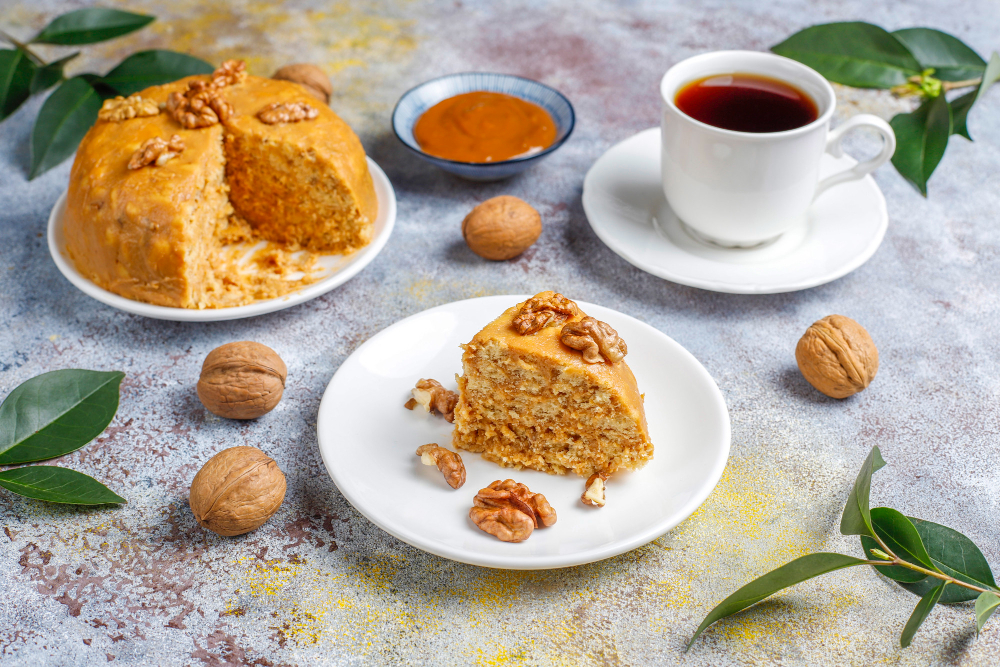
Basbousa is one of the Middle East’s most recognisable semolina desserts, celebrated for its golden surface, dense yet tender texture, fragrant syrup, and characteristic diamond-shaped pieces. Unlike the light and airy sponge cakes familiar in many Western baking traditions, basbousa is deliberately substantial. Its identity comes from semolina rather than ordinary wheat flour, and its final texture is created through a generous soaking of sugar syrup after baking.
Often associated with Egypt and widely prepared across the Middle East and North Africa, basbousa appears under several regional names and with numerous variations. Depending on the country, family tradition, or bakery, it may be called basbousa, namoura, hareesa, or another local name. Closely related semolina syrup cakes can also be found in neighbouring culinary traditions, including revani in Turkey and Greece. These connections demonstrate how recipes can travel across regions, adapting to local ingredients and culinary customs while preserving a recognisable core technique.
At its simplest, basbousa combines semolina, sugar, fat, and dairy or other moistening ingredients into a thick batter. The mixture is baked until golden, scored into individual portions, and then soaked with sweet syrup. Almonds are frequently pressed into the centre of each piece, while coconut, rose water, orange blossom water, lemon, or other flavourings may be added depending on the recipe.
Yet basbousa is more than a sweet cake. Its popularity reflects the importance of grain-based desserts, fragrant syrups, hospitality, and shared family food traditions across the region. It is a dessert that looks simple but expresses a remarkably rich culinary history.
What Exactly Is Basbousa?
Basbousa can best be described as a syrup-soaked semolina cake. The use of semolina distinguishes it from conventional flour-based cakes and gives it a characteristic crumb that is slightly grainy, dense, moist, and pleasantly substantial.
Semolina is produced from durum wheat and is widely used across Mediterranean, Middle Eastern, North African, and South Asian cuisines. In basbousa, it provides the structural foundation of the dessert. Instead of creating a delicate sponge, the semolina forms a more robust cake capable of absorbing a significant amount of syrup without completely losing its shape.
The cake is generally baked in a shallow rectangular or square pan. Before or after baking, it is divided into squares or diamonds, creating individual pieces that can be easily served. Whole almonds are commonly placed on top of each portion, giving the dessert its instantly recognisable appearance.
The final stage is perhaps the most important. Sugar syrup is poured over the freshly baked cake, allowing the liquid to penetrate the semolina crumb. The result is a dessert that combines a lightly browned exterior with a moist, syrup-rich interior.
The Long Culinary History of Semolina Sweets
The precise origin of modern basbousa is difficult to assign to one place or moment. Like many traditional foods, its history appears to have developed through the movement of ingredients, cooking techniques, and recipes across interconnected regions.
Historical food scholarship has connected basbousa and related semolina sweets to older grain-based desserts from the Arab and Islamic culinary world. The Oxford Companion to Food has suggested a possible connection between basbousa and ma’mounia, an older sweet associated with the Abbasid period. Other historical interpretations connect the broader family of semolina syrup desserts to earlier grain-based sweets and halwa-like preparations.
The development of related desserts under different names further illustrates this culinary evolution. Ottoman-era food traditions also contain recipes for semolina-based cakes soaked in syrup. A recipe for revani appears in the 1844 Ottoman cookbook Melceü’t-Tabbâhîn, demonstrating that the concept of baking semolina with rich ingredients and then soaking the finished cake in syrup had already become established in the region.
Rather than searching for one definitive inventor of basbousa, it is more useful to understand the dessert as part of a larger historical family of grain-based sweets. Its modern form represents generations of adaptation, regional interpretation, and household experimentation.
Why Semolina Defines the Dessert
The most important ingredient in basbousa is semolina. Without it, the dessert loses much of the texture that makes it distinctive.
Ordinary wheat flour generally produces a softer and more elastic crumb. Semolina behaves differently. Its granular structure gives the finished dessert a satisfying bite and allows it to absorb syrup while retaining its identity.
The precise type of semolina used can influence the final result. Some recipes favour finer semolina for a softer texture, while others use medium or coarser grains to produce a more pronounced grain character. Modern recipes vary considerably in this respect, which is one reason why basbousa can taste and feel different from one kitchen to another.
This flexibility is part of the dessert’s appeal. Basbousa does not depend on one rigid formula. Instead, it provides a basic framework that cooks can adapt according to local ingredients and personal preferences.
The Role of Yogurt, Butter and Ghee
Although semolina creates the foundation, other ingredients determine how the cake develops its texture and flavour.
Yogurt is frequently used in contemporary basbousa recipes. It adds moisture and a mild tanginess that helps balance the sweetness of the syrup. It also contributes to the soft texture of the finished cake. Butter or ghee provides richness, while ghee can introduce a deeper, more pronounced aroma.
Some recipes include eggs, while others rely more heavily on yogurt and chemical leavening. Baking powder can provide modest lift, but basbousa is not intended to become a highly aerated cake. Its dense structure is part of its character.
This makes basbousa fundamentally different from desserts where the goal is maximum lightness. Here, richness, tenderness, grain texture, and syrup absorption matter more than volume.
The Fragrance of Rose Water and Orange Blossom
Sweetness is only one part of basbousa’s flavour profile. Fragrance can be equally important.
Rose water and orange blossom water are frequently associated with Middle Eastern sweets and can be incorporated into the syrup or batter. These ingredients add floral aromas that transform a basic sugar syrup into something more distinctive.
Orange blossom water provides a bright, citrus-floral character, while rose water gives a more pronounced floral perfume. Lemon juice may also be incorporated into the syrup, helping introduce acidity that prevents the sweetness from becoming completely one-dimensional. Modern recipes demonstrate how combinations of sugar, water, lemon, and floral waters can create a syrup that complements the semolina rather than simply making the dessert sweeter.
The balance is important. Floral waters are powerful ingredients, and excessive quantities can overpower the roasted grain and dairy flavours of the cake. The best versions use fragrance as an accent rather than allowing it to dominate.
The Syrup Is the Heart of Basbousa
The defining moment in basbousa preparation occurs after the cake leaves the oven.
A sugar syrup made from water and sugar is poured over the freshly baked cake, allowing it to penetrate the semolina. Lemon juice or floral waters may be incorporated depending on the recipe. This process transforms the texture of the dessert.
A properly soaked basbousa should not simply have syrup sitting on its surface. The liquid should travel into the crumb, creating moisture throughout the cake. The semolina structure is particularly well suited to this process because it can absorb considerable liquid while remaining relatively firm.
The temperature relationship between the cake and syrup can vary between recipes, but many modern preparations deliberately use cooled syrup over a hot cake. The hot cake is able to absorb the syrup as it enters the porous structure. King Arthur Baking’s contemporary recipe, for example, instructs cooks to pour the syrup slowly over the hot cake after baking and allow the dessert to cool before serving.
This soaking process is what separates basbousa from an ordinary semolina cake. Without the syrup, it is simply a baked semolina mixture. With the syrup, it becomes the rich, moist dessert recognised across the region.
The Characteristic Diamond Shape
Basbousa is often immediately recognisable because of its presentation.
The cake is usually scored into squares or diamonds, with an almond frequently positioned in the centre of each portion. This creates a geometric surface pattern that remains visible after baking and soaking.
The diamond shape is not merely decorative. Scoring the cake before or during the preparation process helps establish serving portions and makes it easier to distribute the syrup throughout the individual pieces.
The almond provides a visual marker for each portion while contributing a contrasting nutty flavour and texture. Some regional and contemporary variations use other nuts, including pistachios or walnuts, while others omit nuts entirely.
The result is a dessert that can be prepared in a large tray and divided into many individual portions, making it especially practical for gatherings.
Basbousa Across the Middle East
One of the most interesting aspects of basbousa is the diversity of names and regional interpretations associated with the dessert.
In Egypt, the name basbousa is particularly familiar. In parts of the Levant, similar desserts may be known as namoura or hareesa, while related preparations appear under different names elsewhere. Closely related semolina cakes also exist in Turkish and Greek culinary traditions under the name revani or ravani.
These desserts should not necessarily be treated as completely identical. Differences in eggs, yogurt, coconut, nuts, citrus, floral waters, fat, sweetness, and preparation technique can produce significantly different results.
What connects them is the underlying culinary idea: a grain-based cake or sweet is baked and then enriched with syrup.
This is a useful reminder that food traditions rarely respect modern national borders. Culinary ideas often travel through migration, trade, empires, religious communities, family relationships, and shared agricultural traditions.
Coconut and Other Regional Variations
Coconut is a common ingredient in many modern basbousa recipes, particularly those influenced by Egyptian and broader Middle Eastern home-baking traditions. It contributes a subtle tropical aroma and additional texture, but it is not essential to every version.
Some preparations are more heavily focused on semolina itself, while others incorporate coconut, almonds, yogurt, cream, or tahini. Contemporary recipes demonstrate considerable variation in the ingredient combinations used to create the cake.
This variation is one reason it is difficult to define a single universally correct basbousa recipe. Family recipes often carry their own proportions and techniques, with some versions intentionally denser and others softer.
In certain preparations, tahini is used to grease the baking pan or contribute additional flavour. Other versions may incorporate cream-based fillings or toppings, creating a richer interpretation of the traditional dessert.
These adaptations show how basbousa continues to evolve without losing its central identity.
Basbousa and Middle Eastern Hospitality
Traditional desserts frequently carry social meanings that extend beyond taste, and basbousa is no exception.
A tray of basbousa can produce many portions, making it naturally suited to family gatherings, celebrations, religious occasions, and visits from guests. Its ability to remain moist after preparation also makes it convenient for advance preparation.
Food traditions surrounding Ramadan and Eid often place particular importance on sweets and generous hospitality. Basbousa can appear within these broader celebratory dessert traditions, alongside other syrup-soaked pastries and sweets.
The dessert’s presentation also supports communal eating. A large tray can be cut into individual pieces and served to several people, turning an uncomplicated baked sweet into part of a shared social experience.
Its cultural significance therefore comes not only from its ingredients but also from the occasions in which it is served.
What Makes Basbousa Different From Baklava?
Basbousa is sometimes compared with baklava because both belong to the broad family of Middle Eastern sweets associated with syrup and nuts. However, their structures are fundamentally different.
Baklava is built from thin layers of pastry, usually combined with nuts and fat before being baked and finished with syrup. Basbousa is a cake-like preparation built around semolina.
The difference becomes especially obvious when the desserts are eaten. Baklava offers crisp, flaky layers and a pronounced contrast between pastry and nuts. Basbousa offers a dense, tender grain-based crumb saturated with syrup.
Both demonstrate the importance of syrup in Middle Eastern dessert traditions, but they achieve very different textures through completely different techniques.
Basbousa Compared With Modern Cakes
The growing popularity of basbousa outside the Middle East is partly connected to the global interest in desserts that have strong cultural identities.
Modern Western cake traditions often focus on softness, airiness, buttercream, chocolate, or elaborate decoration. Basbousa follows another philosophy. Its decoration is comparatively restrained, its ingredients are familiar, and its texture is intentionally dense.
The syrup becomes the finishing element rather than frosting. The almond provides a simple visual accent rather than elaborate decoration. Semolina supplies structure instead of refined wheat flour.
This simplicity gives basbousa a distinctive identity in today’s dessert landscape. It can feel both traditional and surprisingly contemporary because its texture and flavour differ so clearly from standard cakes.
Basbousa in Modern Restaurants and Bakeries
Although basbousa has deep roots in home cooking, it has also entered modern restaurant and bakery culture.
Contemporary chefs can reinterpret the dessert by changing its shape, introducing cream fillings, modifying the syrup, using different nuts, or pairing it with ice cream and other components. In Israel, for example, the restaurant Machneyuda helped elevate basbousa into a prominent restaurant dessert, with its version becoming influential among other establishments.
This illustrates a broader pattern in contemporary food culture. Traditional dishes are increasingly being treated as foundations for culinary creativity rather than fixed historical objects.
The challenge is to innovate without removing the qualities that make the original meaningful. With basbousa, those qualities include semolina, syrup, fragrance, texture, and the sense of generosity associated with a tray of shared dessert.
Why Basbousa Travels So Well
Basbousa has several qualities that make it naturally adaptable to different countries.
Its core ingredients are relatively accessible. Semolina, sugar, dairy, butter or ghee, and nuts are widely available across many food markets. The preparation does not require specialist pastry equipment, and the dessert can be made in a single baking dish.
Its strong texture also makes it suitable for transportation and advance preparation. Unlike fragile layered pastries, basbousa can be cut into pieces and stored in a container while maintaining much of its character.
These practical qualities help explain why variations of the dessert have appeared well beyond its traditional Middle Eastern setting. Contemporary recipes and food communities continue to introduce basbousa to new audiences, including communities in East Africa and elsewhere where semolina-based sweets already have cultural familiarity.
The Appeal of a Dessert Built Around Texture
One of basbousa’s greatest strengths is its texture.
The first impression is often the soft, syrup-saturated interior. As the dessert is bitten, however, the semolina provides a subtle graininess that prevents it from becoming indistinguishable from a conventional moist cake.
The contrast between the golden baked surface and the tender interior adds another layer of sensory interest. Almonds introduce crunch, while coconut can add additional texture in recipes that include it.
This combination demonstrates why texture is just as important as flavour in successful desserts. Basbousa does not depend entirely on sweetness. Its appeal comes from the interaction between roasted grain, fat, dairy, syrup, floral fragrance, and nuts.
The Future of Basbousa
Basbousa’s future is likely to involve both preservation and experimentation.
Traditional bakeries and households can continue making familiar regional versions while contemporary restaurants reinterpret the dessert for modern menus. International food media and global interest in Middle Eastern cuisine can also introduce new audiences to its distinctive character.
There is room for lighter sweetness, alternative toppings, different grains, plant-based versions, and creative flavour combinations. Yet the most successful adaptations will probably retain the central structure that defines the dessert.
The continued popularity of basbousa demonstrates that traditional food does not need to remain unchanged to survive. A recipe can evolve while maintaining the ingredients, techniques, memories, and cultural associations that give it meaning.
Conclusion
Basbousa is much more than a syrup-soaked semolina cake. It is a dessert shaped by the culinary history of the Middle East, the versatility of wheat, the fragrance of floral waters, the richness of butter and ghee, and the cultural importance of hospitality and shared sweets.
Its defining character comes from contrast. Semolina provides a firm grain-based structure, while syrup introduces moisture and sweetness. The golden baked surface contrasts with the tender interior, and almonds or other nuts add texture. Floral waters can provide fragrance, while lemon can bring brightness to the syrup.
Its history is equally layered. Rather than belonging exclusively to one modern country, basbousa exists within a broader family of semolina-based syrup desserts that developed across interconnected culinary regions. Names such as namoura, hareesa, and revani demonstrate how similar techniques can acquire different identities as they move between communities.
What makes basbousa especially compelling is its ability to remain both humble and celebratory. It can be prepared at home in a simple baking tray, yet it can also appear on sophisticated restaurant menus. It can accompany family gatherings, religious celebrations, afternoon tea, or an ordinary dessert craving.
In an increasingly global food culture, basbousa offers a reminder that culinary identity is often preserved through texture, technique, memory, and repetition. Its golden surface and syrup-soaked crumb may look simple, but behind them lies a long tradition of Middle Eastern baking that continues to adapt while retaining its unmistakable character.
Online Internship with Certificate
You may be interested
Taro Leaf Rolls: Leaf Structure and Safe Cooking Influence a Wrapped Vegetable Dish
Anshika Jain - October 26, 2026Taro leaf rolls demonstrate how a simple leafy vegetable can become the foundation of a distinctive and satisfying dish. Found in different forms across tropical regions, taro…
Acorn Jelly: Korean Dotorimuk and the Science of Starch
Anshika Jain - October 26, 2026Acorn jelly is a distinctive food made by transforming the seeds of oak trees into a smooth, firm, sliceable preparation. Best known in Korea as dotori-muk or…
Kabak Tatlisi: Turkish Pumpkin Dessert with a Glossy, Syrupy Finish
Anshika Jain - October 26, 2026Kabak Tatlısı is a traditional Turkish dessert that transforms an everyday autumn vegetable into a glossy, syrup-coated sweet through a remarkably simple cooking process. Prepared by slowly…
Most from this category
Moustalevria: Traditional Greek Grape-Must Pudding with Natural Sweetness
Anshika Jain - October 26, 2026
Kisiel: Traditional Fruit Dessert That Reveals the Science of Starch Thickening
Anshika Jain - October 26, 2026
Tinginys: Lithuania’s No-Bake Biscuit Dessert with a Distinctive Chocolate Mosaic
Anshika Jain - October 26, 2026
Moustalevria: Traditional Greek Grape-Must Pudding with Natural Sweetness
Anshika Jain - October 26, 2026Kisiel: Traditional Fruit Dessert That Reveals the Science of Starch Thickening
Anshika Jain - October 26, 2026Tinginys: Lithuania’s No-Bake Biscuit Dessert with a Distinctive Chocolate Mosaic
Anshika Jain - October 26, 2026

Leave a Comment