

Kardinalschnitten: Austria’s Elegant Layered Dessert of Sponge, Meringue and Cream

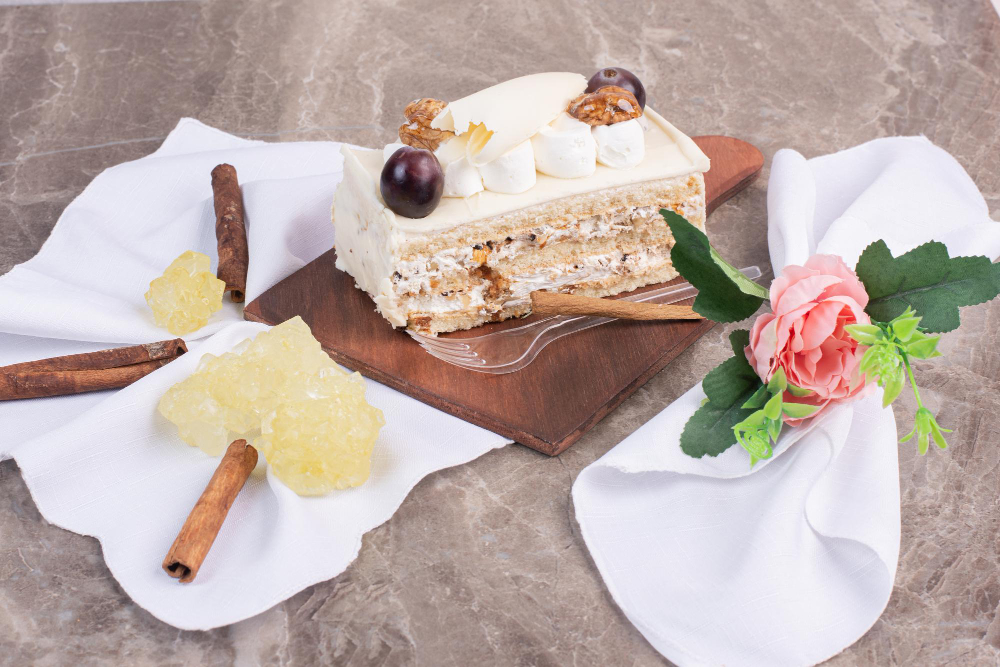
Austria is known for a rich tradition of coffee-house desserts, delicate pastries and carefully prepared cakes. Among its distinctive sweet creations is Kardinalschnitten, an elegant layered dessert made with alternating strips of soft sponge cake and crisp, airy meringue, traditionally filled with whipped cream. Its contrasting textures and refined appearance make it a memorable example of Austrian pastry craftsmanship.
The name Kardinalschnitten is commonly translated as “cardinal slices” or “cardinal cuts”. The dessert is recognised by its characteristic light-coloured and golden-brown layers, which create a striped appearance when the pastry is assembled. A filling of whipped cream, sometimes flavoured with coffee or combined with fruit, sits between the delicate baked layers. Once chilled and cut into portions, the dessert reveals its distinctive pattern.
Kardinalschnitten is traditionally prepared with eggs. Egg whites are essential to the meringue, while egg yolks are commonly used in the sponge component. As a result, the classic dessert is not suitable for an egg-free vegetarian diet. Its traditional preparation is nevertheless worth exploring because it illustrates how Austrian bakers use simple ingredients and precise techniques to create a dessert with a sophisticated texture and appearance.
The Austrian Background of Kardinalschnitten
Kardinalschnitten belongs to Austria’s wider tradition of fine pastries and café desserts. Austrian baking culture developed through a combination of regional culinary practices, imperial-era influences and the growth of urban coffee houses. Cities such as Vienna became especially associated with elaborate cakes, tortes, pastries and sweet dishes served alongside coffee.
The Austrian coffee-house tradition gave desserts an important social setting. Coffee houses became places where people met, read newspapers, discussed public affairs and spent time over carefully prepared refreshments. Cakes and pastries were not merely sweet accompaniments; they were part of the wider experience of hospitality and presentation. Desserts such as layered cakes, cream-filled pastries and meringue-based creations became closely associated with this culture.
Kardinalschnitten fits naturally into this tradition. Its construction is more delicate than that of an ordinary sponge cake because the baker must prepare separate sponge and meringue mixtures before combining them in a single baked structure. The result is a pastry that looks decorative without depending on complicated external decoration. Its appeal comes from the contrast between the golden meringue, tender sponge and smooth cream filling.
Although the dessert is strongly associated with Austria, specific details about its invention and the identity of its original creator are not consistently documented. It is therefore more accurate to describe it as a traditional Austrian pastry than to attribute it to a particular baker or year without reliable historical evidence.
Understanding the Name and Appearance
The word Kardinalschnitten combines Kardinal, meaning cardinal, with Schnitten, a German word used for slices or cut portions. The name is generally connected with the dessert’s distinctive colours and layered appearance. Its pale and golden-brown stripes have often been associated with the ceremonial clothing of Catholic cardinals.
The visual design is one of the dessert’s most recognisable features. Rather than using a single sponge sheet, the preparation creates alternating sections of sponge and meringue. These are baked together, producing a structure that can be filled and sliced. When viewed from the side, the finished pastry displays contrasting bands that make each portion visually distinctive.
The name also reflects the importance of presentation in traditional European pastry-making. A dessert can be recognised not only by its flavour but also by its shape, colour and method of assembly. Kardinalschnitten demonstrates this principle particularly well because its identity depends on the relationship between its baked layers and creamy centre.
The Main Components of Kardinalschnitten
Kardinalschnitten is built around three principal elements: sponge cake, meringue and cream filling. Each component has a different purpose, and the final result depends on their balance.
Sponge Cake Layers
The sponge component provides structure and a soft, tender texture. Traditional recipes commonly use eggs, sugar and flour, with the ingredients combined to create a light batter. Depending on the recipe, the mixture may be prepared by separating the eggs or by whipping whole eggs with sugar until they become pale and aerated.
The sponge should be light enough to complement the meringue but stable enough to hold the filling after assembly. Excessive mixing after the flour is added can remove air from the batter, making the baked layer dense. Careful folding helps preserve the trapped air that contributes to its soft texture.
The flavour of the sponge is generally mild. This allows the meringue and cream to remain prominent without making the dessert excessively rich or strongly flavoured. Vanilla may be added for fragrance, although the exact flavouring depends on the recipe.
Meringue Layers
Meringue is the second defining component. It is made by whipping egg whites with sugar until the mixture becomes thick, glossy and capable of holding its shape. When baked, it develops a delicate outer structure and a light interior. Its sweetness contrasts with the relatively mild sponge.
The quality of the meringue depends on several details. The mixing bowl and whisk should be clean and free from grease because fat can interfere with the formation of stable egg-white foam. Sugar must be incorporated gradually enough to dissolve properly and support a smooth mixture. Overbeating can also affect the final texture, so the mixture should be whipped until it reaches the consistency required by the recipe rather than being beaten without limit.
In Kardinalschnitten, the meringue is not simply placed on top as a decorative topping. It is an integral baked layer that forms part of the dessert’s structure. Its appearance and texture are central to the pastry’s identity.
Cream Filling
The cream filling brings moisture and softness to the baked layers. Whipped cream is a common choice because it provides a smooth, airy centre without overpowering the delicate sponge and meringue. It is usually sweetened lightly and may be flavoured with vanilla or coffee.
Coffee is a particularly suitable flavouring because Austrian coffee-house culture has a long association with coffee-based desserts. A coffee-flavoured cream introduces a gentle bitterness that balances the sweetness of the meringue. Some versions use fruit, jam or other flavourings to create a different balance of sweetness and acidity.
The cream should be whipped until it holds its shape but remains smooth. If it is overwhipped, it may become grainy or begin to separate. Since the filling is placed between fragile baked layers, it should be firm enough to support the structure while remaining soft and pleasant to eat.
How Kardinalschnitten Is Traditionally Prepared
The preparation of Kardinalschnitten requires more coordination than a basic sponge cake because the sponge and meringue mixtures must be prepared separately. Both are then shaped into alternating strips before baking. The exact method differs between recipes, but the underlying principle remains consistent.
The process begins with preparing the sponge batter. Eggs and sugar are whipped until the mixture becomes light and aerated, after which flour is incorporated carefully. In recipes that separate the eggs, the yolks are usually combined with sugar while the whites are whipped independently and folded into the mixture. The objective is to retain as much air as possible so that the baked sponge remains tender.
This arrangement creates the characteristic striped structure. During baking, the sponge sets while the meringue dries and develops a delicate outer surface. Temperature and baking time must be controlled carefully because the two components behave differently. Excessive heat can brown or dry the exterior too quickly, while insufficient baking can leave the structure unstable.
After baking, the combined layers are allowed to cool. The pastry is then filled with whipped cream, either as one large assembled sheet or in individual sections depending on the chosen method. The filled layers are placed together and chilled so that the cream becomes more stable and the dessert can be sliced neatly.
The final portions are usually cut into rectangular or square slices. A light dusting of icing sugar may be used as a finishing touch. The exposed sides reveal the alternating sponge and meringue bands, with the cream forming a soft central layer.
The Importance of Texture and Balance
The appeal of Kardinalschnitten depends on the contrast between its components. The sponge should be soft and light, the meringue should offer a delicate sweetness, and the cream should provide a smooth, cool filling. If one element dominates, the dessert loses some of its characteristic balance.
A dense sponge can make the pastry feel heavy, particularly when combined with sweet meringue and cream. A meringue that is too hard may become difficult to cut and eat, while one that is insufficiently baked may lose its structure when filled. The cream must also be handled carefully because too much moisture can soften the baked layers.
Chilling is an important part of the final preparation. It allows the filling to settle and makes the pastry easier to portion. However, the dessert should not be stored for an unnecessarily long period if the goal is to preserve the contrast between the meringue and cream. Meringue naturally absorbs moisture, so its texture changes after contact with a moist filling.
A well-made Kardinalschnitten is therefore not defined by sweetness alone. It is the combination of air, softness, delicate crispness and creaminess that gives the dessert its distinctive character.
Coffee and Other Flavour Variations
Although the classic structure is based on sponge, meringue and cream, Kardinalschnitten can be adapted through different fillings and flavourings. Coffee is one of the most recognisable variations. A small quantity of strong coffee or espresso can be incorporated into the cream to create a flavour that connects the pastry with the Austrian coffee-house tradition.
Vanilla cream offers a more delicate version. Its gentle fragrance allows the contrast between sponge and meringue to remain the main feature. Fruit-based fillings can introduce freshness and acidity, which may help balance the sweetness of the baked layers. Depending on the recipe, berries, apricot or other fruit flavours may be used.
Chocolate can also be introduced through a light chocolate cream or a small amount of grated chocolate. However, heavier fillings can change the dessert’s character and make it less delicate. Traditional-style preparations generally benefit from fillings that complement rather than overpower the baked layers.
These variations demonstrate the flexibility of the basic structure. The essential identity of Kardinalschnitten remains its combination of sponge and meringue, even when the cream filling changes.
Kardinalschnitten and Austrian Coffee-House Culture
Kardinalschnitten is best understood within the wider context of Austrian dessert culture. Austrian pastries are often designed to accompany coffee, tea or other warm drinks, and their presentation reflects a tradition of careful preparation. A slice of cake served with coffee is a familiar part of the café experience, particularly in Vienna.
The dessert’s light structure makes it suitable for an afternoon coffee break or as a sweet course after a meal. Its layered appearance also makes it appropriate for pastry-shop displays and special occasions. Unlike a heavily decorated celebration cake, Kardinalschnitten relies on its internal construction to create visual interest.
The relationship between pastry and coffee is especially meaningful in Austria, where coffee houses have historically served as social and cultural spaces. Desserts are often selected not only for their flavour but also for how well they complement the drink being served. The mild sponge, sweet meringue and cream filling create a combination that pairs naturally with unsweetened coffee.
Is Traditional Kardinalschnitten Suitable for an Egg-Free Vegetarian Diet?
Traditional Kardinalschnitten is not suitable for an egg-free vegetarian diet. Eggs are essential to its classic preparation, particularly because the meringue depends on whipped egg whites. The sponge component also commonly contains whole eggs or separated egg yolks and whites.
This distinction is important because a dessert may be vegetarian in the broader sense while still being unsuitable for someone who avoids eggs. In many culinary contexts, vegetarian food may include dairy products but exclude meat and fish. An egg-free vegetarian diet has an additional restriction, and traditional Kardinalschnitten does not meet it.
The meringue presents the main technical challenge for an egg-free adaptation. Egg whites provide the proteins that form the stable foam responsible for meringue’s structure. Replacing them requires a different ingredient and a carefully adjusted method. Aquafaba, the liquid from cooked chickpeas or canned chickpeas, is sometimes used as a plant-based alternative for creating foam. However, an aquafaba-based version would be an adaptation rather than the traditional preparation, and its baking performance may differ.
The sponge would also need to be reformulated without eggs. Depending on the recipe, ingredients such as plant-based yoghurt, suitable commercial egg replacers or combinations of raising agents and liquid may help create a soft cake layer. The cream filling could be made with dairy cream if dairy is acceptable, or with a suitable plant-based whipping alternative.
Even when these substitutions are successful, the final dessert should be described as an egg-free interpretation of Kardinalschnitten rather than the classic Austrian preparation. This distinction respects the traditional recipe while making room for dietary adaptations.
Serving and Presentation
Kardinalschnitten is generally served chilled or slightly cool, allowing the cream filling to remain stable when sliced. The portions are usually cut to show the layered interior clearly. A clean, sharp knife helps create neat edges, although the delicate meringue may still crack slightly during cutting.
A light dusting of icing sugar is a simple finishing option. Some presentations include a small amount of fruit or a restrained garnish, but elaborate decoration is not necessary. The alternating sponge and meringue strips are already visually distinctive.
The dessert pairs well with black coffee, espresso or lightly brewed tea. Since the cream and meringue contribute sweetness, a drink without added sugar can create a more balanced combination. It can be served as an afternoon pastry, at a family gathering or as part of a dessert selection featuring other Austrian specialities.
Storage and Freshness
Because Kardinalschnitten contains whipped cream and delicate baked layers, storage requires attention. Once assembled, it should be kept refrigerated and protected from strong odours. Cream-based desserts should not be left at room temperature for extended periods, particularly in warm conditions.
The texture is best enjoyed while the meringue still retains some of its original character. As it comes into contact with the cream, moisture gradually softens it. This change is natural, but it means the dessert may become less crisp over time. For the best result, the baked layers and cream can be prepared separately and assembled closer to serving, depending on the recipe.
Freezing is generally not ideal for an assembled Kardinalschnitten because whipped cream can change texture after thawing and the meringue may become soft. Fresh preparation and appropriate refrigeration are usually better choices for preserving its intended consistency.
What Makes Kardinalschnitten Distinctive?
Kardinalschnitten stands out because it uses a relatively small number of familiar ingredients to create a visually striking and texturally complex dessert. Its identity comes from the combination of sponge and meringue rather than from a complicated decoration or an unusually rich flavouring.
The pastry also reflects a broader principle in European baking: technique can be as important as the ingredient list. The baker must prepare two different mixtures, preserve the air in each, bake them together successfully and assemble the layers without damaging their structure. The final result depends on accuracy and patience.
Its connection with Austrian café culture gives the dessert an additional dimension. Kardinalschnitten is not simply a sweet cake; it is part of a culinary tradition in which pastries are designed to be enjoyed slowly, often alongside coffee and conversation. Its refined appearance and light texture make it a distinctive example of that tradition.
Conclusion
Kardinalschnitten is an elegant Austrian layered dessert made with sponge cake, meringue and a smooth cream filling. Its characteristic striped appearance, delicate texture and optional coffee flavour make it a recognisable part of Austria’s wider pastry culture. The dessert demonstrates how careful preparation and the contrast between simple components can produce a sophisticated result.
Its traditional preparation relies on eggs, especially for the meringue and commonly for the sponge. It is therefore not suitable for an egg-free vegetarian diet in its classic form. Plant-based alternatives can be explored, but they should be understood as modern adaptations rather than traditional Kardinalschnitten.
For anyone interested in Austrian desserts, Kardinalschnitten offers a useful glimpse into the country’s baking heritage and coffee-house traditions. Its appeal lies in the harmony of soft sponge, airy meringue and creamy filling, brought together in a pastry whose beauty becomes visible with every slice.
Online Internship with Certificate
You may be interested
Celtuce: Exploring the Chinese Vegetable Valued for Its Thick, Crisp Stem
Anshika Jain - November 6, 2026Celtuce is a distinctive Chinese vegetable cultivated primarily for its thick, tender and crisp stem. Although it belongs to the lettuce family, its appearance and culinary uses…
Chayote: Exploring the Crisp and Versatile Squash Used in Savoury Cooking
Anshika Jain - November 6, 2026Chayote is a mild, crisp squash that has become an important ingredient in several regional food traditions around the world. Recognised by its light-green colour, pear-like shape…
Basbousa: Egypt’s Traditional Semolina Cake Loved Across the Middle East
Anshika Jain - November 6, 2026Basbousa is one of the most recognisable traditional desserts of Egypt and the wider Middle East. Made primarily from semolina, sugar, butter or ghee, and milk or…
Most from this category
Malva Pudding: South Africa’s Famous Soft Sponge Dessert With a Creamy Sauce
Anshika Jain - November 6, 2026
Aloo Ke Gutke — Uttarakhand: The Traditional Pahadi Potato Preparation
Anshika Jain - November 5, 2026
Eromba — Manipur: A Traditional Mash of Vegetables, Chillies and Fermented Flavours
Anshika Jain - November 5, 2026Malva Pudding: South Africa’s Famous Soft Sponge Dessert With a Creamy Sauce
Anshika Jain - November 6, 2026Ringan No Olo: Exploring Gujarat’s Smoky Roasted Aubergine Delicacy
Anshika Jain - November 6, 2026


Leave a Comment