

Knafeh: The Middle Eastern Dessert With Crispy Layers and Creamy Filling

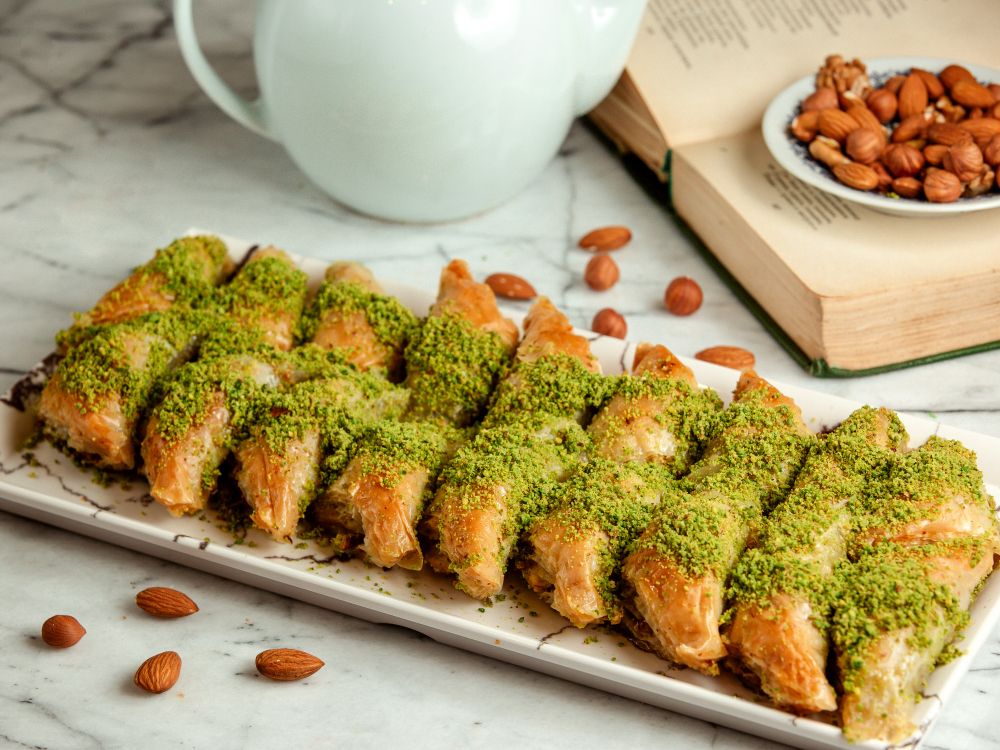
Few desserts demonstrate the relationship between tradition and modern food culture as clearly as Knafeh. Known by several spellings and regional variations, including Kunafa, Kanafeh and Knafeh, this Middle Eastern dessert combines crisp pastry, a rich filling, aromatic syrup and toppings such as pistachios to create a contrast of textures that has made it one of the region’s most recognisable sweets.
Knafeh has a long culinary history across the Middle East, with different cities and communities developing their own interpretations. In some versions, delicate strands of shredded pastry surround a cheese-based filling, while other preparations use cream, semolina or other dairy mixtures. The dessert is generally finished with a sweet syrup, often flavoured with rose water or orange blossom water, and decorated with pistachios or other nuts. The result is simultaneously crisp, creamy, fragrant and intensely sweet.
Yet Knafeh is no longer confined to traditional bakeries and family celebrations. In recent years, it has become part of a global dessert phenomenon. Its most visible transformation has been through the rise of Dubai-style chocolate, in which crunchy kunafa strands and pistachio filling are enclosed in chocolate. By 2026, this combination had developed into a sustained commercial trend rather than simply a passing social-media novelty. Indian food and gifting businesses have also reported growing demand for kunafa-inspired products, demonstrating how a regional dessert can rapidly enter new culinary markets.
The story of Knafeh is therefore not simply a story about a sweet dish. It is a story about regional identity, culinary adaptation, food entrepreneurship, social media, globalisation and the changing way consumers discover traditional foods.
What Is Knafeh?
Knafeh is a dessert built around a distinctive contrast between crisp pastry and a soft filling. The pastry component is commonly made from fine strands of shredded dough known as kataifi or kunafa pastry. These thin strands are combined with butter or ghee and cooked until they become golden and crisp.
The filling varies considerably depending on the regional style. Cheese is central to some of the best-known versions, producing a warm, stretchy interior that contrasts with the crisp pastry. Other versions use cream or a milk-based filling, creating a softer and more delicate texture.
A sugar syrup is generally poured over the dessert after or during cooking. This syrup may be flavoured with rose water, orange blossom water or other aromatic ingredients. Pistachios are frequently used as a garnish, adding colour, nuttiness and a slight textural contrast.
This combination explains much of Knafeh’s appeal. A bite can contain several sensory experiences at once: the crunch of the pastry, the richness of the filling, the sweetness of the syrup, the aroma of floral water and the nuttiness of pistachios.
The Regional Diversity of Knafeh
It is difficult to describe Knafeh as a single standardised recipe because the dessert exists in several regional forms. Food traditions across the Levant and the wider Middle East have produced variations in pastry, filling, sweetness, colour and preparation.
Nabulsi Knafeh, associated with Nablus, is particularly well known for its cheese filling and distinctive appearance. The dessert has become strongly associated with Palestinian culinary heritage and is often prepared with a soft, unsalted cheese that provides the characteristic melted and stretchy texture.
Other variations use cream or semolina-based fillings instead of cheese. Some are made with fine strands of pastry, while others use a more finely ground pastry mixture. The amount of syrup can also vary considerably, producing desserts that range from intensely sweet and moist to relatively restrained and crisp.
This regional variation is important because it demonstrates that Middle Eastern food culture is not a single culinary category. Knafeh belongs to a broader food landscape in which recipes evolve according to local ingredients, techniques, communities and historical influences.
Why the Texture of Knafeh Matters
The defining characteristic of Knafeh is arguably its texture. Many desserts depend primarily on flavour, but Knafeh is designed around contrast.
The pastry needs to become sufficiently crisp to provide a clear crunch, while the interior should remain soft and rich. Syrup introduces moisture and sweetness, but excessive syrup can overwhelm the pastry and reduce its crispness. This makes the timing and proportion of ingredients particularly important.
The contrast becomes even more pronounced in modern Knafeh-inspired desserts. The viral Dubai chocolate format uses crunchy kunafa strands against a smooth chocolate shell and creamy pistachio filling. This adaptation effectively transfers the traditional textural concept of Knafeh into a chocolate confection.
The popularity of this combination illustrates why traditional culinary techniques can remain relevant even when the original dish is transformed. Consumers may encounter the familiar Knafeh experience through a completely different format.
Knafeh and the Rise of Dubai Chocolate
The modern international story of Knafeh is closely connected with Dubai’s viral chocolate phenomenon. A chocolate bar filled with pistachio cream and crispy kunafa strands became widely circulated on social media, turning the combination into a global food trend.
The appeal was partly visual. When the chocolate was cut open, the green pistachio filling and golden strands of pastry created a striking contrast. Videos showing the texture and filling were particularly suited to platforms driven by short-form visual content.
But visual appeal alone does not explain the longevity of the trend. The combination also brought together familiar ingredients in an unusual form. Chocolate consumers recognised the sweetness and richness of the confection, while Middle Eastern food traditions were represented through pistachio and kunafa.
By February 2026, Gulf News reported that Dubai’s Knafeh-chocolate trend had moved into a new phase, with brands introducing white-chocolate versions of the popular combination. Several Dubai brands were experimenting with variations involving white chocolate, kunafa, saffron and pistachio.
This development illustrates an important feature of modern food trends: once a traditional ingredient combination becomes commercially successful, businesses begin creating variations that allow consumers to experience it in new forms.
From Viral Trend to Indian Food Market
The Knafeh phenomenon has also expanded into India. What began as an international social-media trend increasingly became a product category that Indian food companies could commercialise.
An Outlook Business report published in July 2026 described India’s growing “kunafa obsession” and reported that brands including FNP, SMOOR and Britannia had seen strong demand for kunafa-inspired products. The report characterised the trend as having moved from viral visibility toward sustained commercial interest.
This development is significant because it demonstrates how social media can shorten the distance between a regional food and an international consumer market. A dessert that may have been unfamiliar to many Indian consumers can become recognisable within months when its visual presentation is repeatedly encountered online.
The Indian market also has an existing cultural familiarity with ingredients such as pistachios, milk, cream, sugar and fragrant syrups. This may make some of the flavour combinations associated with Knafeh relatively accessible even when the pastry technique itself is unfamiliar.
Why Knafeh Works So Well on Social Media
Food trends are increasingly influenced by how effectively a dish can communicate through a photograph or short video. Knafeh performs particularly well in this environment because its most important qualities are highly visual.
The golden pastry, glossy syrup, green pistachios and creamy interior create a strong visual contrast. Cutting into the dessert can reveal layers and fillings, while pulling apart a cheese-based Knafeh can demonstrate its elasticity.
The Dubai chocolate adaptation intensified these qualities. A chocolate shell provides a visually familiar exterior, while breaking it open reveals a dramatic interior containing pistachio cream and crunchy kunafa strands.
This combination of recognisable and unfamiliar elements is particularly powerful for social media. Consumers can immediately understand that the product is chocolate, while the filling provides novelty.
The result is a food experience that can be communicated in seconds. A short video can demonstrate the crack of the chocolate shell, the softness of the filling and the crunch of the pastry without requiring a detailed explanation of the dessert’s history.
Knafeh as an Example of Culinary Globalisation
The international rise of Knafeh provides an interesting example of how culinary globalisation works. Food does not simply travel unchanged from one country to another. Instead, recipes are frequently modified to suit new markets.
A traditional Knafeh may be served as a large tray dessert, while an international confectionery business may transform the same flavour combination into a chocolate bar, cookie, cake, ice cream or pastry.
This process can introduce regional ingredients to consumers who might otherwise never encounter them. Pistachio-kunafa combinations, for example, have become increasingly familiar to consumers who may not have previously eaten traditional Knafeh.
At the same time, adaptation raises questions about cultural identity. When a traditional food becomes a global trend, its original history can sometimes become less visible than its commercial image. Consumers may know “Dubai chocolate” without knowing the longer culinary history of kunafa itself.
Understanding Knafeh therefore requires looking beyond its viral forms and recognising the regional food traditions from which those forms emerged.
The Cultural Significance of Knafeh
Knafeh is deeply embedded in the social and culinary life of the Middle East. It is associated with celebrations, family gatherings, hospitality and festive occasions. In many communities, buying or preparing a large tray of Knafeh is connected with sharing rather than individual consumption.
This communal quality distinguishes traditional Knafeh from some of its modern commercial adaptations. A chocolate bar or packaged dessert can be designed for an individual consumer, while a traditional tray of Knafeh is often intended to be cut, served and shared.
Food traditions frequently carry this social dimension. Their importance comes not only from flavour but also from the situations in which they are eaten. Knafeh can therefore represent hospitality, celebration and regional identity alongside its role as a dessert.
Its international popularity provides an opportunity to make these cultural associations more widely understood.
The Importance of Pistachio in Modern Knafeh
Pistachio has become one of the most recognisable ingredients associated with modern Knafeh-inspired desserts. Its green colour creates an immediate visual identity, while its nutty flavour complements both pastry and dairy-based fillings.
The pistachio-Knafeh combination became particularly prominent through Dubai chocolate. The rich pistachio filling combined with crunchy kunafa strands created a flavour profile that was simultaneously familiar and distinctive.
Pistachio also fits naturally into premium food marketing. Its colour, flavour and relatively high perceived value make it suitable for luxury-style confectionery and gifting.
This has contributed to the movement of Knafeh-inspired products beyond traditional dessert shops into premium chocolate, gifting and packaged-food categories.
The Commercialisation of Traditional Desserts
The growth of Knafeh-inspired products demonstrates how traditional foods can become commercial opportunities. Once a dessert gains international attention, businesses can create new product formats, packaging styles and price points.
In India, the trend has been particularly relevant to gifting and premium confectionery. Outlook Business reported that major brands were expanding kunafa-inspired offerings as consumer demand continued beyond the initial viral moment.
This reflects a broader change in the food industry. Consumers increasingly discover products online before encountering them in physical stores. Food companies can monitor social-media conversations and rapidly introduce products designed around emerging tastes.
Traditional desserts therefore have a new pathway to commercial visibility. A regional recipe no longer needs to depend exclusively on tourism or diaspora communities to reach an international audience.
Food Safety and the Expansion of Kunafa
The rapid commercial growth of Knafeh-inspired products also highlights the importance of food safety. As demand increases, production can move from specialist bakeries and restaurants into central kitchens, franchises, packaged-food businesses and large-scale commercial operations.
A recent consumer case in Kerala demonstrates why food safety remains important even when a product is popular. In September 2026, the Palakkad District Consumer Disputes Redressal Commission ordered a dessert outlet and its parent company to pay ₹15,000 after a customer alleged that a metallic object was embedded in a Pista Kunafa dessert. The commission ordered a refund of the purchase price, compensation and litigation costs after finding deficiencies in how the business handled the consumer complaint.
The case does not establish that Knafeh itself is inherently unsafe. Instead, it illustrates a broader issue that becomes increasingly relevant as popular foods are produced and sold at scale. Businesses must maintain appropriate manufacturing controls, ingredient handling, equipment maintenance, hygiene and consumer-response procedures.
Traditional reputation and modern food safety are not opposing concepts. A successful regional dessert needs both cultural authenticity and reliable production standards when it enters a large commercial market.
Knafeh Beyond the Trend
One of the most important questions surrounding the Knafeh boom is whether its popularity will last after the initial social-media excitement fades.
Food trends often move quickly. A visually distinctive product can become extremely popular within weeks and then disappear when consumers move to another novelty. Knafeh has an advantage, however, because it existed long before the current trend.
The dessert does not depend on social media for its cultural relevance. Its traditional forms remain part of Middle Eastern culinary heritage regardless of whether chocolate versions are trending online.
The current trend can therefore be viewed as an additional layer rather than the entire story. Social media has introduced Knafeh to new consumers, while the traditional dessert provides the historical foundation behind the trend.
If consumers move beyond viral chocolate bars and become interested in traditional Knafeh itself, the trend could ultimately contribute to greater awareness of Middle Eastern culinary traditions.
Traditional Knafeh and Modern Creativity Can Coexist
The evolution of Knafeh demonstrates that culinary traditions do not necessarily disappear when they are adapted. Instead, they can acquire new forms.
A modern pastry chef might incorporate Knafeh pastry into a plated dessert. A chocolatier might use kunafa strands inside a chocolate shell. A bakery might create a Knafeh cheesecake or pastry. These products may differ substantially from traditional preparations while still drawing inspiration from the original flavour and texture combination.
The challenge is to acknowledge the source of the inspiration rather than treating the ingredients as disconnected trends. Culinary innovation becomes more meaningful when consumers understand the traditions behind the ingredients.
This is particularly important in an era when food trends can travel globally within days. Cultural context can easily be lost when a recipe becomes a marketing concept.
The Future of Knafeh in Global Food Culture
Knafeh’s future is likely to involve both tradition and experimentation. Traditional bakeries will continue preparing regional versions, while modern food companies will continue adapting its flavours into new formats.
The 2026 experience already demonstrates this dual movement. Dubai businesses have experimented with white chocolate and other variations, while Indian brands have expanded kunafa-inspired products into the gifting and confectionery market.
The dessert’s flexibility makes it particularly suitable for contemporary food culture. Its defining elements—crisp pastry, creamy or cheesy filling, sweet syrup, pistachio and aromatic flavours—can be incorporated into many different formats.
At the same time, increasing commercial demand means that businesses will need to maintain quality and food-safety standards. The Kerala consumer case shows how quickly concerns about product safety can become part of the public conversation surrounding a popular dessert.
Conclusion
Knafeh is a powerful example of how a regional dessert can move from traditional kitchens into global food culture without losing the culinary ideas that made it distinctive. Its combination of crisp pastry, creamy or cheese-based filling, fragrant syrup and pistachios gives it a sensory identity that is immediately recognisable.
Its recent international popularity has been strongly influenced by the rise of Dubai chocolate and social-media food culture. By 2026, the trend had expanded into new variations in Dubai and into sustained commercial demand in India.
Yet Knafeh is more than a viral dessert trend. Its deeper significance lies in the Middle Eastern culinary traditions from which it emerged. The modern popularity of kunafa provides an opportunity for consumers to discover not only a fashionable confection but also a broader regional food culture built around hospitality, celebration, craftsmanship and shared eating.
The dessert’s commercial journey also demonstrates the responsibilities that accompany food popularity. As Knafeh-inspired products enter new markets and are produced on a larger scale, quality control, hygiene and consumer protection become increasingly important. The recent Kerala consumer case involving a Pista Kunafa product illustrates this modern dimension of the dessert’s growing presence in India.
Ultimately, Knafeh represents the meeting point between heritage and innovation. Its traditional forms continue to carry regional identity, while its modern adaptations show how culinary ideas can cross borders, inspire businesses and become part of global food culture. The story of Knafeh is therefore not simply about a sweet with crispy layers and a creamy filling. It is about how food traditions survive, transform and find new audiences in an increasingly connected world.
Online Internship with Certificate
You may be interested

Papeda: Translucent, Elastic Sago Porridge of Eastern Indonesia
Anshika Jain - October 21, 2026Indonesia’s culinary heritage extends far beyond rice, noodles, and familiar fried dishes. Across its eastern islands, communities have developed food traditions shaped by local plants, coastal environments,…
Su Filindeu: Sardinia’s Delicate Pasta Made by Repeatedly Stretching Dough
Anshika Jain - October 21, 2026Italian cuisine is famous for its remarkable diversity of pasta shapes, textures, and preparation techniques. From familiar spaghetti to intricate stuffed varieties, each form reflects regional ingredients…
Koloocheh: Filled Pastry Decorated With Intricate Patterns
Anshika Jain - October 21, 2026Traditional pastries often tell stories about the communities that prepare them. Their ingredients reflect regional agriculture, while their shapes and preparation methods preserve generations of culinary knowledge.…
Most from this category
Kachri ki Sabzi: Wild Desert Melon Dish That Reflects Rajasthan’s Food Heritage
Anshika Jain - October 21, 2026
Kachri ki Sabzi: Wild Desert Melon Dish That Reflects Rajasthan’s Food Heritage
Anshika Jain - October 21, 2026Hawaijar: The Pungent, Sticky Fermented Soybean Food of Manipur
Anshika Jain - October 21, 2026Anishi: Traditional Ao Naga Made From Fermented Colocasia Leaves
Anshika Jain - October 21, 2026
Papeda: Translucent, Elastic Sago Porridge of Eastern Indonesia
October 21, 2026
Koloocheh: Filled Pastry Decorated With Intricate Patterns
October 21, 2026

Leave a Comment